

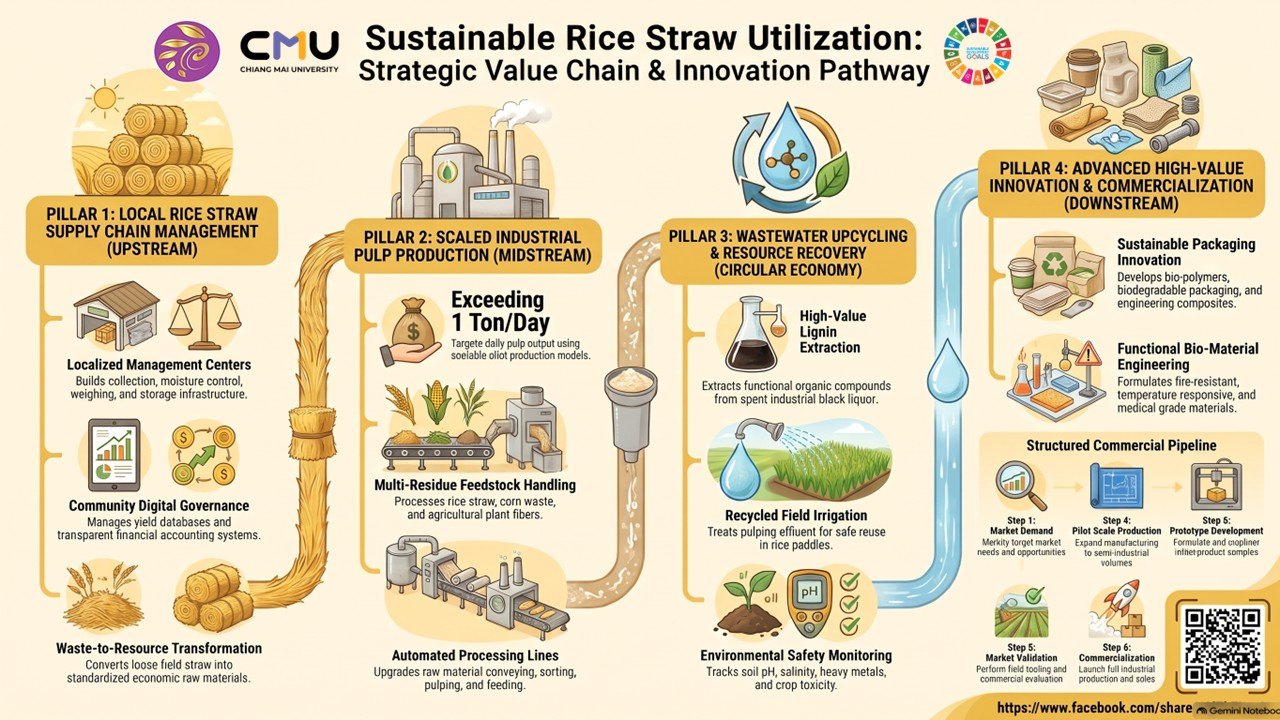
Rice straw is left over after the rice harvest. It can be turned into straw pulp to make packaging and eco-friendly building materials.
Chiang Mai University has mapped out a rice straw value chain built on four pillars: collecting straw in local communities, producing pulp at industrial scale, recovering resources from the wastewater, and developing high-value materials ready for commercial use.
A value chain in 4 pillars
1. Upstream: local rice straw supply chain
Local management centers handle collection, moisture control, weighing and storage. A community digital system keeps yield records and transparent financial accounts, and loose field straw becomes a standardized raw material with economic value.
2. Midstream: industrial-scale pulp production
A target of more than 1 ton of pulp a day from scalable pilot production. The line takes several feedstocks (rice straw, corn waste and other agricultural plant fibers), with automated conveying, sorting, pulping and feeding.
3. Circular economy: wastewater upcycling and resource recovery
Lignin and other functional organic compounds are extracted from spent black liquor. Treated pulping effluent is reused safely in rice paddies, with monitoring of soil pH, salinity, heavy metals and crop toxicity.
4. Downstream: high-value innovation and commercialization
Bio-polymers, biodegradable packaging and engineering composites, plus functional bio-materials such as fire-resistant, temperature-responsive and medical-grade materials.
The road to market
- 1
Market demand
Identify target market needs and opportunities.
- 2
Pilot-scale production
Expand manufacturing to semi-industrial volumes.
- 3
Prototype development
Formulate and engineer finished product samples.
- 4
Market validation
Run field trials and a commercial evaluation.
- 5
Commercialization
Launch full industrial production and sales.
 1
 2
 3
 4
 5
 7
 8
 9
 10
 11
 12