This device has no English text-to-speech voice, so the article may not be read aloud.
The Wonder of Mutant Rice Becoming the Rice of the Future When breeders run out of ways to add new traits to an existing variety, looking for a shortcut by inducing mutations is brought into play, as in the past when the black tulip, rust-resistant soybean, stem-borer-resistant soybean, short-duration Khao Dawk Mali (RD15) and glutinous rice (RD6) were found. But the limitation of conventional mutation breeding is that tracking mutants is difficult and inefficient, because it relies on phenotype. In addition, mutation breeding does not keep the population for later use, which is a high cost...
Targeting Induced Local Lesions IN Genomes (TILLING) is a process for obtaining organisms with changes in desired genes, where the change is induced in the organism's genetics. TILLING is regarded as reverse genetics because it targets the mutant gene first and then studies the mutant trait.
The main components of TILLING consist of 1) inducing mutations in the organism; 2) finding organisms with mutations in the desired gene or chromosome position; 3) testing for mutant traits in the organism. The history of TILLING in plants has been reported in Arabidopsis, oats, Brassicas, cantaloupe, soybean, barley, rice, peas, tomato, wheat and maize, and in animals in Drosophila, C. elegans and zebrafish. Commonly used mutagens include chemicals such as ethyl methanesulfonate (EMS), methyl nitrosourea and diepoxybutane, and radiation such as fast neutrons, gamma rays and ion beam irradiation.
Objectives of Thai TILLING • Create a permanent mutant population for finding and analyzing the roles and functions of genes • Develop methods for screening and collecting the mutant population to serve as a data resource for study and for verifying the roles and functions of those genes • Apply mutant rice in rice breeding
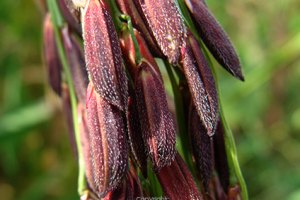
The mutant rice population is created using Hom Nin non-glutinous rice, a photoperiod-insensitive rice with a 90–100 day harvest age and good nutritional value. This variety mutates easily when induced by radiation or chemicals. It also has the advantage that its grain, leaf and stem colors differ clearly from ordinary rice, and once a mutant is found it can be crossed with almost any rice variety well. The mutant population was created by inducing Hom Nin seed with fast neutron radiation at 33 Gy at the Thailand Institute of Nuclear Technology, using 100,000 starting seeds (M0). M1 was then grown in the field in 96-sample plate format to collect M2 seed. M2 seed from the same M1 plant were then pooled, and 8 M2 seeds were randomly sampled and grown to represent each M1 line. The population was then reduced to 24,000 lines, and the M3 generation was grown out by the same method as M2, and to date a total of 21,024 lines have had M4 seed collected.
Creating diversity in rice starch
To screen mutant rice with amylose content and cooked starch temperature different from normal Hom Nin non-glutinous rice, a new technique called Half-seed amylose content (HSAC) was developed so many mutant lines could be screened at the same time. Screening found mutant rice with amylose content profiles from 5–36% and with cooked starch temperature mutated at the same time.
Creating heat-tolerant rice
The effect of high temperature on the various growth stages that affect yield and yield components was studied by screening mutant Hom Nin rice under a high temperature of 42 °C. Screening of 9,000 mutant lines found 200 lines that could set seed.