

This device has no English text-to-speech voice, so the article may not be read aloud.
Rainfed rice breeding in Thailand: importance, goals, products, methods and strategy
01
The importance of rainfed rice in Thailand
Rice is Thailand's staple food and a major economic crop. It plays a part in food security, ways of life, culture and people's incomes, especially for rural farming households. Rainfed rice is a production system that depends on rainfall as its main water source, so it is found mostly outside irrigated areas, particularly in the North and the Northeast, which are important producing regions for jasmine rice and glutinous rice. Data compiled by FFTC indicate that rainfed fields account for about 76% of the total rice-growing area, and that several million farming households depend on this production system. [https://ap.fftc.org.tw/article/3072]
Nearly half of the country's agricultural land is rainfed, and about 3.7 million households grow rice there for their own consumption and for income. Rice production in these areas is therefore important both for farmers' livelihoods and for national rice output. However, yield depends on the amount and distribution of rainfall, which is uncertain. In some years heavy rain causes flooding, while in others rain is scarce or interrupted and drought occurs; in some areas both flooding and drought can strike within the same year. In addition, fluctuating temperatures affect rice growth and yield formation.
The Northeast also faces soil constraints, especially saline soils and soils of low fertility. At the same time, rice diseases and insect pests such as blast, bacterial leaf blight, brown planthopper, whitebacked planthopper and gall midge can damage yields. Varieties widely grown in rainfed areas, such as Khao Dawk Mali 105 and RD6, have grain quality and characteristics that consumers want, but they remain limited in their tolerance to diseases, insects and harsh environments, and their yield potential may not be enough to cope with production risks.
The importance of rainfed rice is also tied to the country's rice consumption and trade. Thai jasmine rice, especially Khao Dawk Mali 105 and RD15, is known in overseas markets for its aroma and cooked-rice quality, while glutinous rice RD6 is a key variety eaten in the North and the Northeast. Non-glutinous and white rice of various kinds are everyday foods across the country. Rice is also a raw material for processing and the food industry, so rice varieties relate to farmers' incomes, market demand and the food culture of each region.
Rainfed areas contain a diverse range of sub-ecosystems, which can be classified by land level and water condition into 4 types: upland, semi-upland/semi-lowland, lowland and flood-prone fields. Each type has different constraints in water, soil, disease and insects. Variety development should therefore consider suitability for the ecosystem and the specific risks of each area: high-risk areas should aim to stabilize yield, while areas with favorable conditions should aim to raise yield potential. Choosing varieties that suit local conditions helps farmers use resources efficiently and increase rice productivity.
In the context of climate change, uncertain rainfall and temperature may increase the risk of drought, flood and extreme heat, which affect cultivated area, yield and farmers' wellbeing. [https://www.eastwestcenter.org/sites/default/files/2024-02/EWC%20API-N163%20Draft%2001.pdf] Rice variety development is therefore an important way to increase the adaptability of the production system, with two main goals: stabilizing yield, by improving existing varieties to resist major diseases and insects and to tolerate unfavorable environments such as flood, drought, high or low temperature and saline soil; and raising yield potential, by developing varieties with suitable yield components, such as large panicles, many grains per panicle, a high number of panicles per plant and good grain weight, together with strong stems that do not lodge, efficient water use, good photosynthesis, tolerance to the environment, resistance to diseases and insects, and grain quality suited to consumption and processing.
For these reasons, improving Khao Dawk Mali 105 and RD6 is necessary. They are key varieties directly tied to production, consumption and farmers' incomes in rainfed areas, yet they still face constraints from variable weather, unsuitable soils and rice diseases and insects. Breeding them for greater resistance and tolerance while keeping the grain quality that consumers and markets demand will reduce damage and production risk, stabilize farmers' yields and incomes, and support food security and the long-term competitiveness of Thai rice.
Stabilizing farmers' yields and incomes, and supporting food security and the long-term competitiveness of Thai rice.
02
Goals of rainfed rice breeding
A rainfed rice breeding program should cover 4 key areas of traits.
- 01
Keep quality close to Khao Dawk Mali 105 (KDML105) or RD6, in aroma, amylose content, gel consistency and gelatinization temperature
- 02
Increase resistance to diseases and insects: Leaf and Neck Blast, Bacterial Leaf Blight and Brown Planthopper
- 03
Increase tolerance to abiotic stresses: submergence, drought and salinity
- 04
Increase yield and lodging resistance, to keep yield stable in variable environments and reduce losses from lodging before harvest
03
Target products and methods
Improve Khao Dawk Mali 105 using Marker Assisted Selection technology to assist selection in a backcross breeding process, to obtain improved lines that are genetically close to Khao Dawk Mali 105 (Essentially Derived Varieties (EDV)) but are tolerant of submergence, drought and salinity, and resistant to blast, bacterial leaf blight and brown planthopper.
Improve glutinous rice RD6 using Marker Assisted Selection technology to assist selection in a backcross breeding process, to obtain improved lines that are genetically close to RD6 (EDV) but are tolerant of submergence, drought and salinity, and resistant to blast, bacterial leaf blight and brown planthopper.
04
Strategy for rainfed rice breeding
Defining the recipient and donor rice varieties
Recipient: Khao Dawk Mali 105 (using the germplasm of the Ubon Ratchathani Rice Research Center) and RD6 serve as recipient varieties, or base varieties, because they are the target varieties whose cooking quality and aroma, the characteristic traits of both varieties, must be kept to meet market demand.
Donor: a variety with good traits that we want to add to the recipient. Donors must be considered on the basis of confirmed resistance or tolerance, and are selected from rice germplasm both in Thailand and from abroad, as follows.
- 01
Selecting blast-resistant rice varieties
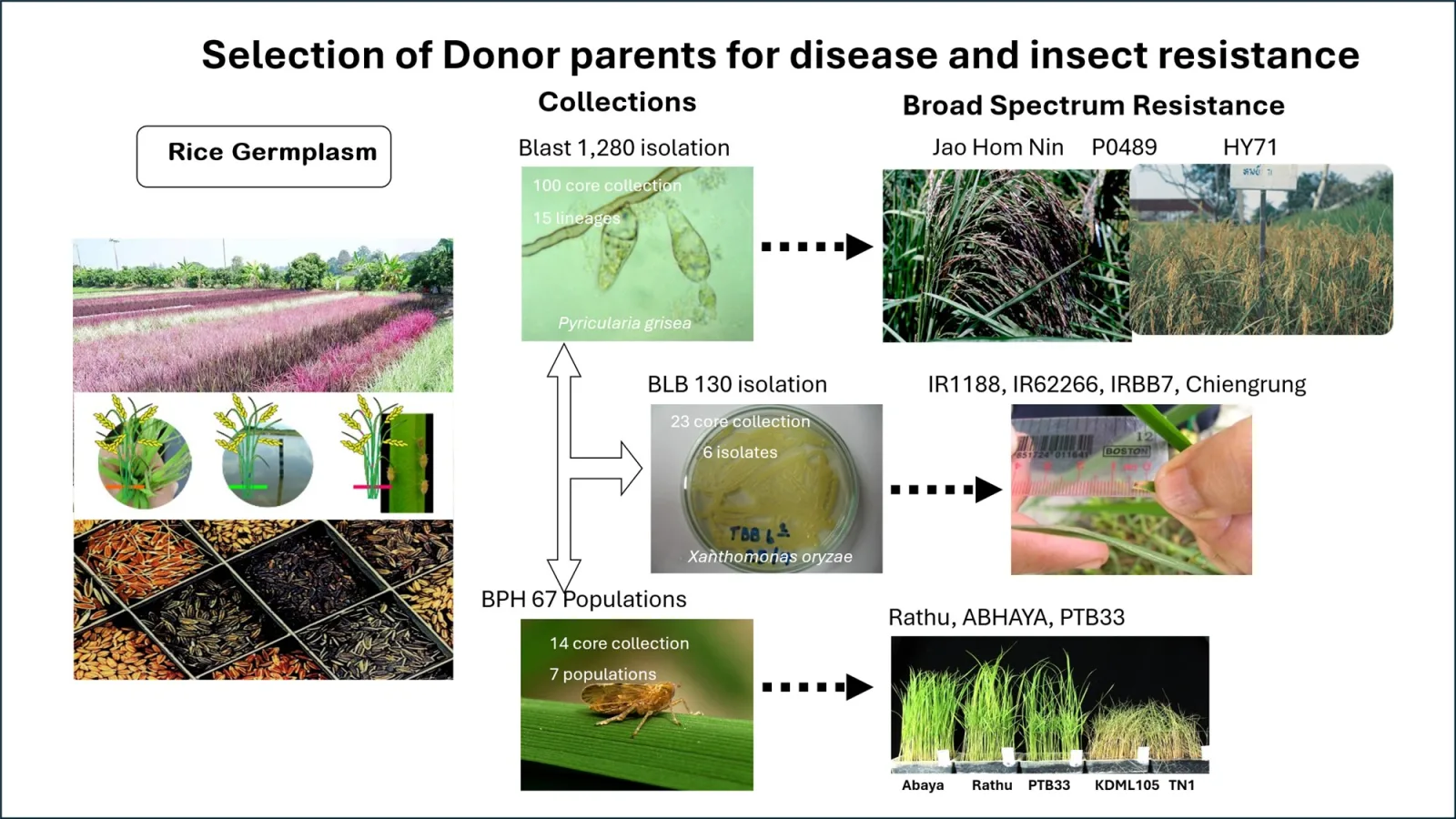
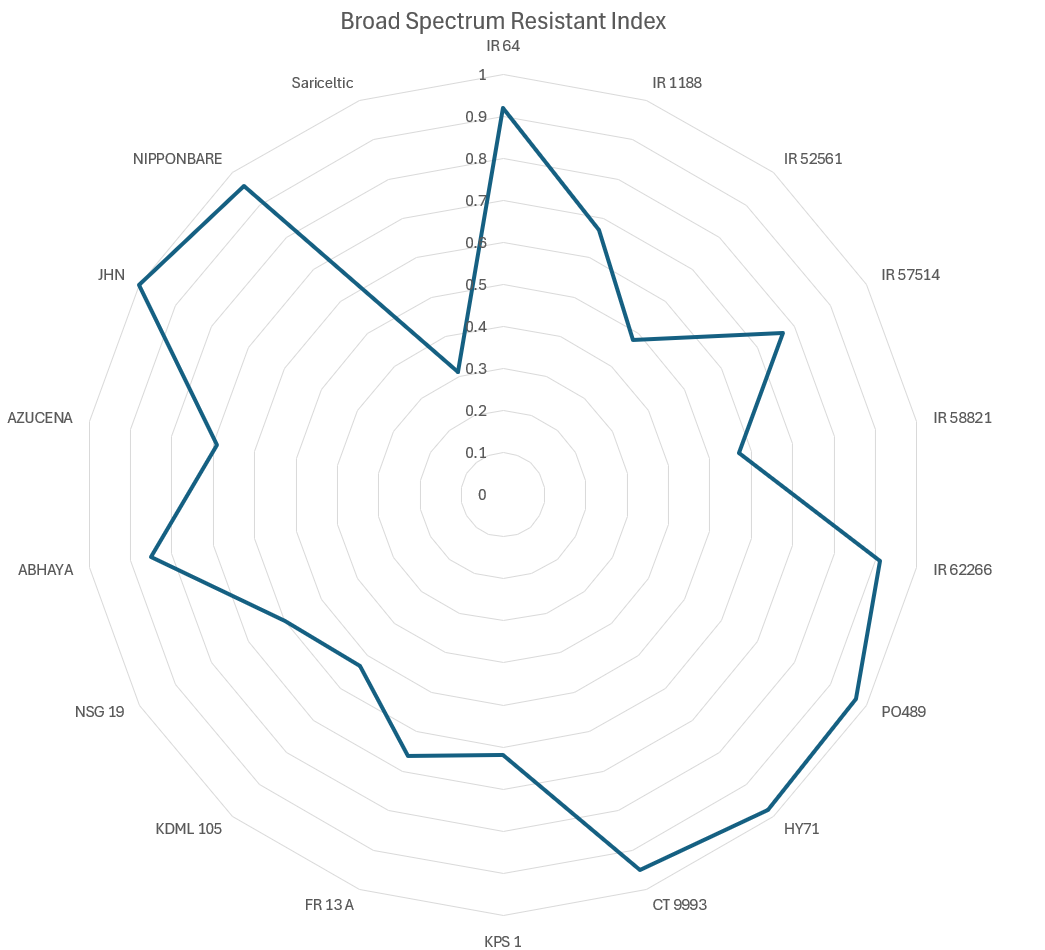
Blast is caused by the fungus Magnaporthe oryzae. The work began by collecting 1,280 isolates of the blast pathogen (single spore isolation) and sorting them, then selecting a core collection of 100 isolates, grouped by genetic diversity into 15 races, to evaluate the resistance of rice varieties that could serve as genetic sources for improving blast resistance. From testing a large number of varieties, Jao Hom Nin, IR64, P0489 and HY71 were found to have broad resistance to the blast pathogen (Broad spectrum resistance (BSR): resistance to many of the 15 races (lineages)), so they have the potential to be used as resistance gene donors for breeding rice with good blast resistance.
- 02
Selecting bacterial leaf blight (BLB)-resistant rice varieties
Bacterial Leaf Blight is caused by the bacterium Xanthomonas oryzae. A total of 130 isolates of the pathogen were collected, and a core collection of 23 isolates was selected, classified into 6 races, to evaluate the resistance of rice varieties that could serve as genetic sources for improving bacterial leaf blight resistance. From testing a large number of varieties, IR1188, IR62266, IRBB7 and Chiengrung were found to have fairly broad resistance to the bacterial leaf blight pathogen (Broad spectrum resistance (BSR) to 6 races), so they have the potential to be used as resistance gene donors for breeding rice with good bacterial leaf blight resistance.
- 03
Selecting brown planthopper (BPH)-resistant rice
Brown planthopper is caused by the insect Nilaparvata lugens (Stål). A total of 67 populations of brown planthopper were collected from rice-growing areas across the country, and a core collection of 14 populations was selected, classified into 7 population groups (biotypes), to evaluate brown planthopper resistance in varieties that could serve as genetic sources. From testing a large number of varieties, Rathu Heenati, ABHAYA and PTB33 were found to be highly resistant to brown planthopper, and Rathu Heenati and PTB33 show broad-spectrum resistance (BSR) at all growth stages except the heading stage, compared with susceptible varieties such as KDML105 and TN1. They therefore have the potential to be used in breeding rice for resistance to brown planthopper.
- 04
Selecting submergence-tolerant rice varieties
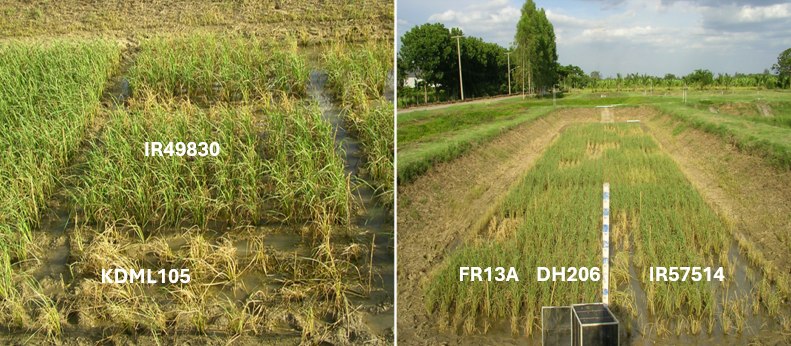
Tolerance is evaluated at 2 rice growth stages, the seedling stage and the tillering stage, by looking at % survival and recovery after the water recedes. From testing a large number of varieties, FR13A, DH206, IR57514 and IR49830 were found to tolerate submergence better than other varieties.
- 05
Selecting salt-tolerant rice varieties
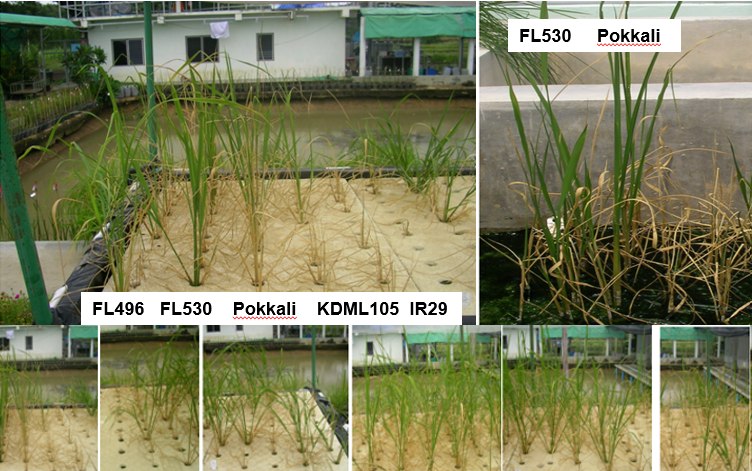
Tolerance is evaluated in 2 environments, at salinity levels of about 4 - 12 dS/m electrical conductivity: plants grown in pots or large seedling trays soaked in saltwater (saltwater-grown plants), and plants grown in a nutrient solution system (hydroponics). Evaluation is carried out at the 3-week-old seedling stage and at the heading stage, looking at salt injury and grain set. From testing a large number of varieties, Pokkali, FL530 and FL496 were found to tolerate salinity well.
- 06
Selecting drought-tolerant rice varieties
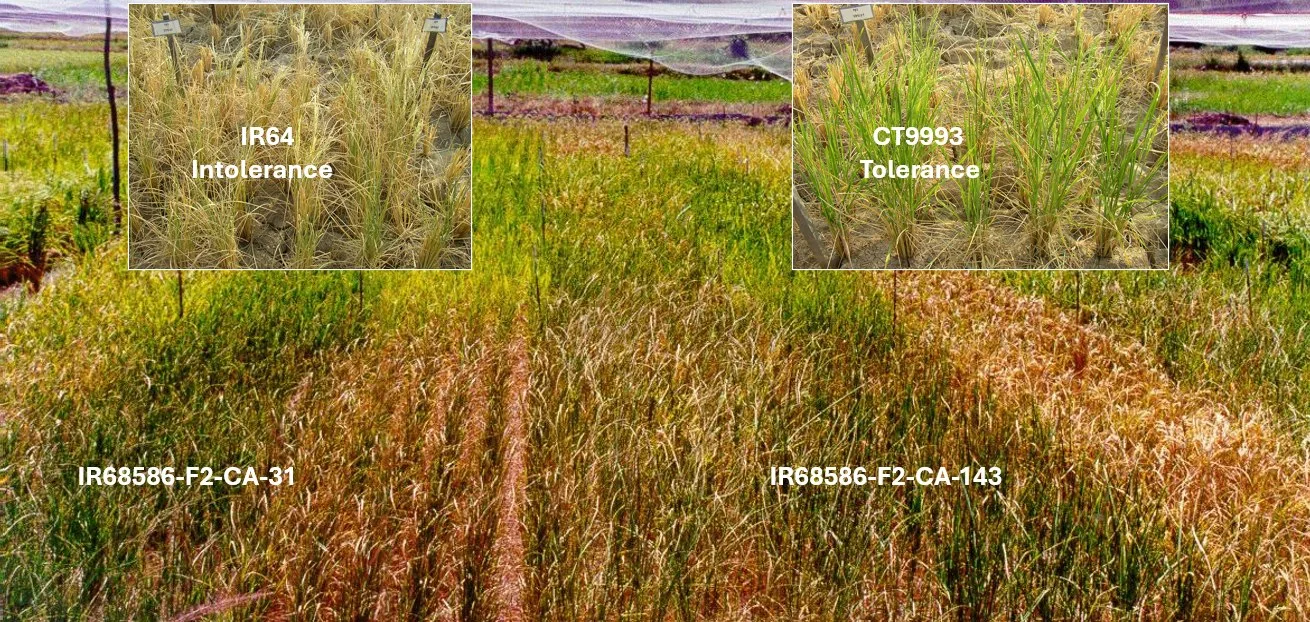
Tolerance to drought or water deficit is evaluated throughout the growth period (vegetative to reproductive stages). There are several testing methods, but for rainfed work the test is run under a Line Source Sprinkler (LSS) system, which can create a gradient of water deficit from well-watered to severe drought. The varieties IR68586-F2-CA-31, IR68586-F2-CA-143, IR58821 and IR57514 were found to tolerate water deficit well and to have a variety of drought tolerance mechanisms.
05
Identifying the number, location and effect of QTL, and identifying nearby molecular markers
Identifying the number, location and effect of QTL related to various traits was carried out continuously on several rice populations from a variety of projects, some of which already had genome maps. At that time the molecular markers in use were still microsatellite markers (SSR), and some populations already had a Restriction Fragment Length Polymorphism (RFLP) framework map (anchored markers), with more molecular markers added to the genetic map for greater detail.
Testing the expression of phenotypes under various environments and stresses was carried out jointly by several agencies, especially the Rice Gene Discovery Unit, Kasetsart University, and the Rice Department, to identify the number, location and effect of QTL for important traits, and to identify molecular markers associated with the genes or QTL for those traits, which can be used to track the inheritance of those traits in the progeny of breeding programs. The populations used are shown in Table 1, and the results are summarized in Table 2.
Table 1. Populations used for QTL mapping to identify the number, location and effect of QTL related to various traits for rainfed rice
| Cross | Population type | Number of lines | Target traits for QTL discovery |
|---|---|---|---|
| KDML105 x Jao Hawm Nin | F7-RIL | 587 | BL, SUB, Fe, protein |
| Azucena x IR64 | DH | 110 | BL, stem borer, aroma |
| Azucena x IR64 | BIL | 59 | DT |
| KDML105 x CT9993 | RIL | 141 | Cooking quality |
| CT9993 x IR62266 | DHL | 220 | DT, BLB, Alk |
| FR13A x CT6241-17-1-5-1 | RIL | 172 | SUB |
| IR49830-7-1-2-2 x CT6241-17-1-5-1 | DHL | 65 | SUB |
| DH206 x KDML106 | BIL | 108 | SUB |
| Abhaya x KDML105 | BIL | 123 | BPH |
| Rathu Heenati x KDML105 | F2 | 250 | BPH |
| PTB33 x RD6 | F2 | 250 | BPH |
| IR1188 x KDML105 | BIL | 64 | BLB |
| IR62266 x KDML105 | F2 | 240 | BLB, GT |
| IR57514 x KDML105 | F7-RIL | 2,000 | SUB, Cooking quality |
| IR68835-98-2-B-2-1-1 x KDML105 | BIL | 500 | BL |
| IR66946-3R-196-1-1 x KDML105 | BC2 | 250 | ST |
| IR66946-3R-230-1-1 x KDML105 | BC2 | 250 | ST |
Types of Population:
- RIL / F7-RIL: Recombinant Inbred Lines
- DHL: Doubled Haploid Lines
- BIL: Backcross Introgression Lines
- F2: F2 Population
- BC2: Backcross 2 (second backcross population)
Target traits for QTL discovery:
- BL: Blast
- SUB: Submergence tolerance
- Fe: Iron content
- protein: Protein content
- stem borer: Stem borer resistance
- aroma: Aroma
- DT: Drought tolerance
- Cooking quality: Cooking quality
- BLB: Bacterial Blight
- Alk: Alkali spreading value / gelatinization temperature
- BPH: Brown Planthopper resistance
- ST: Salinity tolerance
Table 2. QTL for various traits from QTL mapping, and the DNA molecular markers linked to each QTL (Note: QTL names and DNA molecular markers are the names used in 1999-2004)
| Target traits | Chromosome | QTL (gene) | Favorable-allele donor | DNA molecular marker | Reference |
|---|---|---|---|---|---|
| Submergence tolerance (SUB) | 5 | SubQTLchr5 | FR13A, DH206, IR49830 | R1553 | Toojinda et al (2003) |
| 9 | SubQTLchr9 | FR13A, DH206, IR49830, IR57514RAS | R10783Indel | Toojinda et al (2003), Siangliw et al (2003) | |
| Bacterial leaf blight (BB) | 1 | BlbQTLchr1 | IR1188 | RM302 | Unpublished |
| 5 | BlbQTLchr5 | IR62266 | RM122-RM507 | Unpublished | |
| 11a | BlbQTLchr11a | IR1188 | RM224 | Unpublished | |
| 11b | Xa21 | IR1188 | PB7/PB8 | Chungwongse et al. (1993) | |
| Brown planthopper resistance (BPH) | 6a | Bph3 | Rathu Heenati, PTB33 | RM190 | Unpublished |
| 6b | BphQTLchr6 | Abhaya | RM50 | Unpublished | |
| 12 | BphQTLchr12 | Abhaya | RM277 - RM260 | Unpublished | |
| Leaf and neck blast (BL) | 1 | Pi QTLchr1 | Jao Hawm Nin | RM319-RM212 | Unpublished |
| 2 | Pi QTLchr2 | IR64 | RM208 | Wanchana et al. (2003) | |
| 11 | Pi QTLchr11 | Jao Hawm Nin | RM144-RM224 | Unpublished | |
| 12 | Pi QTLchr12 | IR64 | RM179 | Unpublished | |
| Salinity tolerance (ST) | 1 | SalTolchr1 | FL496, FL530 | RM140, B1.1-1, B1.1-11 | Gregorio et al (2002), Lin et al (2004) |
| Drought tolerance (DT) | 1 | DTQTLchr1 | CT9993 | P-3, RM102, RM104 | Lanceras et al., (2004) |
| 3 | DTQTLchr3 | CT9993 | RM81, RM231 | Lanceras et al., (2004); Zhang et al., (1999) | |
| 4 | DTQTLchr4a | CT9993 | RM252, RM317, RM470 | Lanceras et al., (2004); Zhang et al., (1999) | |
| 4 | DTQTLchr4b | IR62266 | RM252 | Lanceras et al., (2004) | |
| 8 | DTQTLchr8a | CT9993 | RM80, RM447, RM515, RM210 | Lanceras et al., (2004) | |
| 8 | DTQTLchr8b | IR62266 | RM210 | Lanceras et al., (2004) | |
| 9 | DTQTLchr9 | IR68586-F2-CA-31, IR68586-F2-CA-54, IR68586-F2-CA-143 | RM201, RM215, RM242 | Lanceras et al., (2004) | |
| Amylose content | 6 | Wx | KDML105, Jao Hawm Nin | Waxy | Wanchana et al. (2003) |
| Gel consistency | 6 | GCQTLch6 | KDML105 | Waxy-RM204 | Lanceras et al., (2000), Wanchana et al. (2003) |
| Gel temperature | 6 | SSIIa | KDML105 | GT11 | Unpublished |
| 11 | GTQTLch11 | IR62266 | G257 | Unpublished | |
| Aroma | 8 | badh2 | KDML105 | Os2AP | Unpublished |
06
References
- FFTC Agricultural Policy Platform, “Adaptation of Rice Production System to Climate Change in Thailand: Trend and Policy.” https://ap.fftc.org.tw/article/3072
- East-West Center, Drought, Flood, and Rice Security in Central Thailand. https://www.eastwestcenter.org/sites/default/files/2024-02/EWC%20API-N163%20Draft%2001.pdf