This device has no English text-to-speech voice, so the article may not be read aloud.
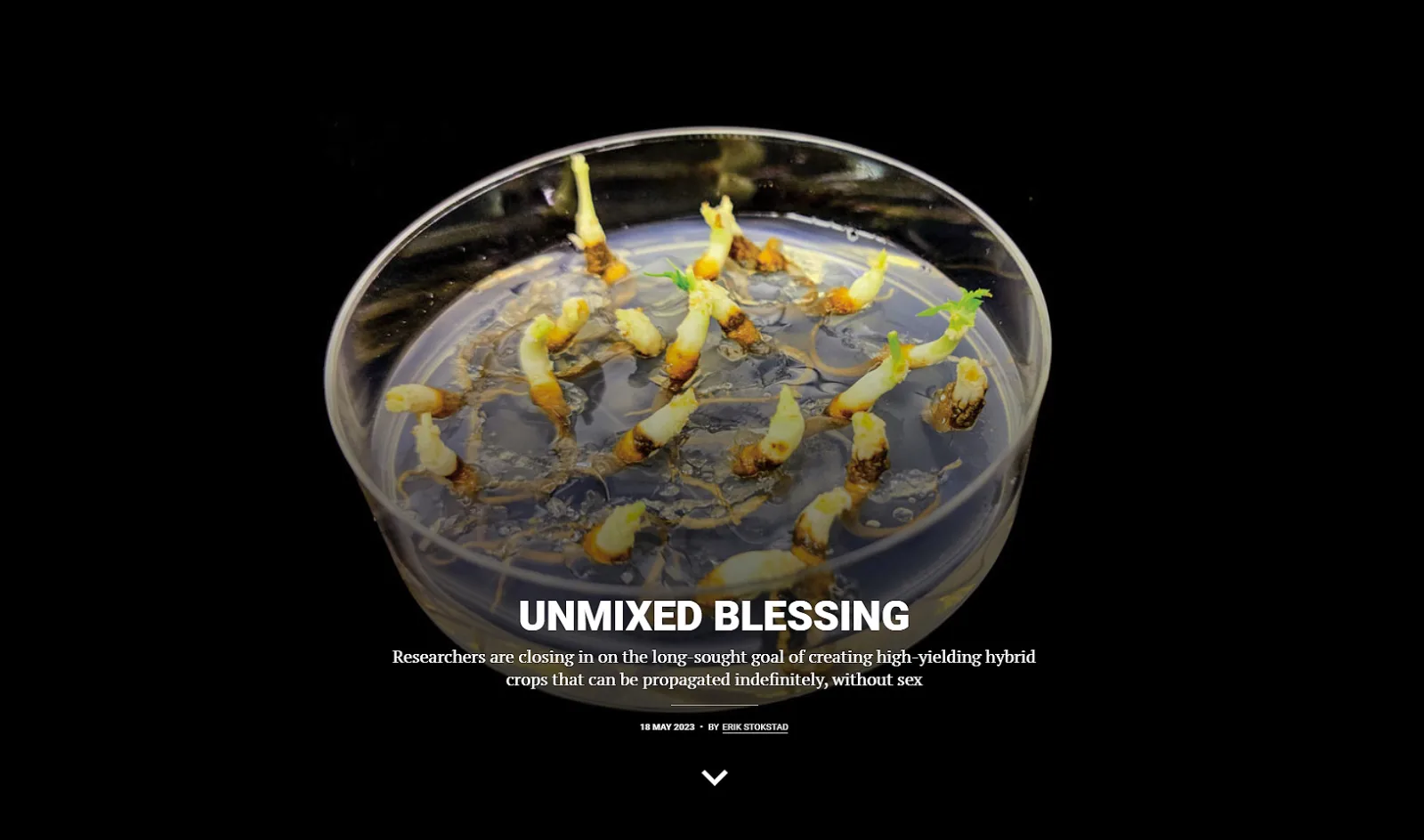
In early summer in Texas and Arkansas, small helicopters are flown over rice fields. The purpose is to use the wind from the rotors to help pollination, which is the method RiceTec uses to produce hybrid rice seed. The resulting varieties yield highly and are popular with farmers in the southern United States. However costly and troublesome the method is, it is still worthwhile given the results, because hybrid seed grows into strong rice plants that adapt well to the environment and, moreover, yield more than normal varieties. This phenomenon is called hybrid vigor, found in hybrids from crossing two varieties, resulting in hybrid lines whose traits are superior to the parent varieties. There is no definitive explanation for this phenomenon, but a widely accepted hypothesis holds that dominant genes from each variety (parents) suppress recessive genes, so only dominant genes are expressed in the hybrid. The result is that hybrid varieties can yield up to 50% more than normal varieties. Moreover, the resulting plants are strong and tolerant of the environment, such as better drought tolerance, a trait also seen in other hybrid crops, such as maize.
In the case of “rice” which is naturally a self-pollinating plant, producing hybrid seed is complicated, unlike maize, which is already cross-pollinated. At present some seed companies produce hybrid rice using helicopters as mentioned above, and this method must be done in every production cycle to keep obtaining hybrids that still show the desired outstanding traits. It is certainly a troublesome, high-cost method. Moreover, farmers must buy new seed every planting cycle, raising farmers' costs even further.
 (From doi: 10.1126/science.adi7882)
For this reason, breeders have tried to look for more efficient methods. One method raised is “Apomixis” which in Greek means “without mixing”. The idea of this method is to enable female reproductive cells, or egg cells, to develop into an embryo without fertilization. If this succeeds, producing hybrid seed would become easy, fast and much cheaper, so it could be sold cheaply, helping smallholder farmers access hybrid seed more easily.
“Apomixis” was first mentioned in the 19th century by the English botanist John Smith, who observed holly plants bearing fruit without pollination or fertilization by male pollen. Since then, serious study began, followed by the discovery of more than 400 plant species in which apomixis occurs naturally. However, this process does not appear in staple crops.
 (From doi: 10.1126/science.adi7882)
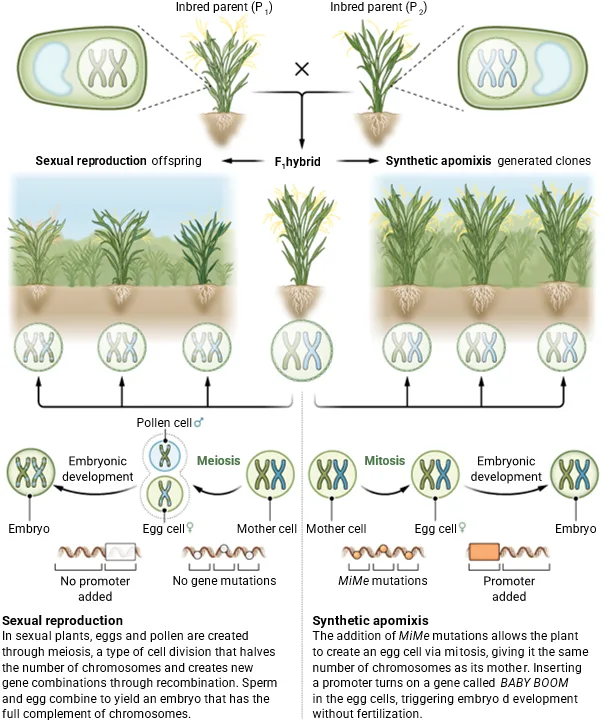
The key thing scientists try to understand is that in natural sexual reproduction, egg cells and sperm are produced by meiotic cell division, which gives reproductive cells with only half the chromosomes (haploid cells), and they develop into an embryo only when fertilized. But in plants that reproduce by apomixis, reproductive cells divide by mitosis, giving cells with the same number of chromosomes (diploid cells), and the resulting egg cells can develop into an embryo without fertilization. We call this process parthenogenesis.
Although apomixis propagation is not yet ready for practical use, dedicated research and cooperation among international research teams have led to many discoveries in the past decade. In 2009, a research team led by Raphaël Mercier of the Max Planck Institute for Plant Breeding Research studied genes involved in cell division and found that knocking out 3 genes involved in meiosis in Arabidopsis could induce reproductive cells arising from mitotic division, and these 3 genes were later called MiMe from “Mitosis instead of Meiosis”. Later, in 2016, the same research team succeeded in making rice produce diploid egg cells that are identical in every way to the mother cell.
Meanwhile, other research teams are studying different mechanisms. In 2002, the geneticist Kim Boutilier discovered the gene BABY BOOM from rapeseed, and when this gene is expressed in Arabidopsis it stimulates stem and leaf tissue to develop into embryos. Later, in 2015, Ozias-Akins and team discovered that the gene BABY BOOM plays an important role in natural apomixis in Pennisetum squamulatum which is one of the grasses. The gene was then transferred to other grasses such as rice and maize, and was found to induce parthenogenesis in both plants. In the latest research from the University of California (UC), Davis, published in Nature Communications in December 2022, success was reported after knocking out the gene MiMe and inserting the gene BABY BOOM in rice. The result was that rice plants could produce 95% clonal seed, which arises from the apomixis process. However, these remarkable successes still need another 5–10 years of research to obtain suitable rice varieties before reaching the market. Judging from the discoveries and research results above, it should not be long to wait, but for now, producing hybrid rice still has to rely on helicopters.
Reference Stokstad, E. (2023). Game-changer-scientists-are-genetically-engineering-crops-clone-themselves. Science. doi: 10.1126/science.adi7882

Article by (author) Erik Stokstad Erik Stokstad is a reporter at Science, covering environmental issues.
Translated and compiled by Watchara Phetluan Watchara.phe@ku.th