This device has no English text-to-speech voice, so the article may not be read aloud.
On 3–10 December every year, Kasetsart University, Kamphaeng Saen Campus holds a research exhibition in which many academic and research works from each unit are displayed to share knowledge.
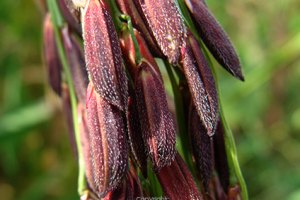
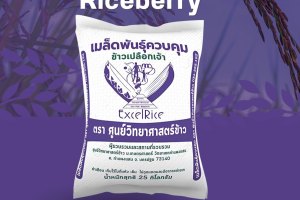
The Rice Science Center and the Rice Gene Discovery Unitset up a booth displaying Thai rice varieties and various rice breeding research, including disease-resistant and insect-resistant rice, Hom Chonlasit rice, Pin Kaset rice, Riceberry, Sin Lek rice, Hom Mali 80 rice, and Kaew Kaset rice with Khao Jao Kam rice.
Thai kings of every era have been closely involved with Thai rice. During the reign of King Ramkhamhaeng the Great, in the 18th Buddhist century (13th century CE), there is evidence of the country's abundance, inscribed on a stone inscription:
“There are fish in the water, and rice in the fields”
King Bhumibol Adulyadej is the “Lord of Agriculture” in keeping with the ancient royal tradition in which the monarch carries out royal duties supporting the morale and spirit of the people.
King Bhumibol Adulyadej the present reign, has always taken an interest in nurturing Thai rice. He once gave a royal address to a group of farmer leaders:
“I have had the chance to study and experiment with rice farming, and I know well that farming rice is difficult and faces no small obstacles. It requires good rice varieties and various kinds of technical knowledge in order to get good results. Another point is that, after the rice-growing season is over, other crops should also be grown in the fields, because this adds a good deal of income, loosens the soil, and adds plant-residue fertilizer that improves the soil, which suits rice farming in the next season.”
This shows his direct interest in the people who are farmers, and is a great royal undertaking to support the morale and spirit of the country's people. The small rice seedlings grown in trays in the picture are for use with a transplanting machine and take 18–20 days to be ready for transplanting. The Rice Science Center displayed them as a beautiful decoration, with the varieties "Khao Jao Kam" and "Kaew Kaset".
Khao Jao Kam Parents: Doi Saket glutinous rice x Hom Nil non-glutinous rice PropertiesA variety selected from a cross population between Doi Saket glutinous rice and Hom Nil non-glutinous rice. It is a non-glutinous rice whose stem, leaves and grains are dark purple to black, photoperiod-insensitive, with good tillering. The selected line has high iron in the grain and high antioxidants. The pericarp colors of this line consist of light brown (procyanidin), red (peonidin) and purple (cyanidin). All the colors of the rice are pigments from flavonoid synthesis in the rice plant, which divides into the synthesis of anthocyanins, namely cyanidin and peonidin, and also the synthesis of proanthocyanidins, namely procyanidin. Kaew Kaset Parents: Hom Suphan x Hom Nil non-glutinous rice PropertiesA variety selected from a cross population between Hom Suphan rice and Hom Nil non-glutinous rice. It is a white non-glutinous rice, photoperiod-insensitive, with very good tillering and high yield. The grains are slender and long, with medium amylose content. Yield 800–850 kg/rai.
Royal address of His Majesty the King at Ban Bang Kradan, Bang Saen Subdistrict, Prachin Buri Province, on 18 November 1998, which said:
“Brown rice is beneficial and makes the body strong. White rice has beautiful grains, but the good parts have all been taken out. Some say the poor eat brown rice. We eat brown rice, so we are poor too.”
Because of His Majesty's address and the spread of nutritional knowledge by various organizations, Thai people today have begun to eat more brown rice, since they know the benefits they will get.